
Centre likely to miss collection target for '09-10
The direct tax collections posted a 20.42 per cent growth totalling Rs 36,733 crore upto October 15, but indirect tax collections were less buoyant, recording about eight per cent growth at Rs 63,413 crore upto September 30, this financial year.

While indirect taxes collections have exceeded revised estimates (RE) by Rs 9,885 crore, direct tax realisations fell short by Rs 4,000 crore over the RE.
The government's tax collections grew by over 14 per cent to Rs 1,63,611 crore (Rs billion) (Rs 1,636,11 billion) till December mainly due to impressive growth in corporate tax.

India's gross tax collections soared to a record high of Rs 27.07 lakh crore in the fiscal year ended March 31, led by impressive growth in corporate tax and customs, taking the tax-to-GDP ratio to an over two-decade high of 11.7 per cent, Revenue Secretary Tarun Bajaj said on Friday.
Tax collections grew by 18 per cent at Rs 2,52,162 crore (Rs 2,521.62 billion), crossing the Budget target and pushing up the tax-GDP ratio to 9.1 per cent, during 2003-04.

With the first quarter gross tax mop-up reaching Rs 5.6 lakh crore, Icra Ratings on Friday said the government is set to exceed the budgeted tax collection target of Rs 22.2 lakh crore for 2021-22, led by indirect taxes. The government has budgeted a modest 9.5 per cent growth in tax collections at Rs 22.2 lakh crore for FY22, over FY21 collections of Rs 20.2 lakh crore. However, despite the second wave of the pandemic, the April-June quarter tax collections rose to Rs 5.6 lakh crore, which is 39 per cent higher than Q1 of FY20.

Government gets Rs 17.1 lakh crore in its kitty
The Finance Ministry on Friday said indirect tax collections are likely to cross Rs 2,00,000 crore (Rs 2000 billion) this fiscal, well above the target of Rs 1,92,215 crore (Rs 1922.15 billion).
Government has missed the overall revised tax collection target for both direct and indirect taxes by Rs 2,288 crore.
The other two components of indirect tax collections -- excise and customs duties -- were already in negative territory since October 2008. In particular, excise -- a levy on factory production levied at the gates - has started declining from September.

After the last Budget's announcement of a major tax relief for those earning an annual salary of less than Rs 12 lakh, there is not much that individuals can look forward to in the forthcoming Budget, points out A K Bhattacharya.

India's gross GST collection increased by 8.1 per cent to over Rs 1.83 lakh crore in February, driven by higher import revenues and improved domestic sales. Despite some states reporting negative or below-average growth, experts see the overall trend as a sign of a maturing tax ecosystem and a confident domestic market.

A recent data released by the Central Statistics Office (CSO) confirm that both the manufacturing and mining sectors shrunk in 2013-14 with fall in output.

The net direct tax collections jumped by 18 per cent to Rs 43,391 crore during the first two months of the current fiscal.

India's like-for-like gross Goods and Services Tax (GST) revenue growth slowed to a five-year low of 5.57 per cent in FY26, reaching Rs 23.32 trillion, primarily driven by a significant surge in import revenues.

Police in Lucknow busted a gang that misused the Mudra loan scheme to create fake GST firms and commit input tax credit fraud worth approximately Rs 1.3 crore.

A shift appears underway in India's tax landscape. States with relatively smaller tax collections like Odisha and Telangana are emerging as the fastest-growing contributors to indirect and direct tax collections, respectively.
Festive buying spree unleashed by lower tax rates pushed gross GST collection to about Rs 1.96 lakh crore in October, registering a 4.6 per cent year-on-year growth -- the slowest rate so far this fiscal.
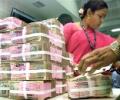
The Centre mopped up Rs 2.46 lakh crore from indirect taxes in the last fiscal, as much as Rs 2,000 crore (Rs 20 billion) more than the revised target, despite stimulus packages.

Net direct tax collection in the April-June quarter of the current fiscal rose by 41 per cent to Rs 3,54,569.74 crore, Minister of State for Finance Pankaj Chaudhary informed the Lok Sabha. During the April-June period of 2021-22, the government had collected a net direct tax of Rs 2,50,881.08 crore. At the same time, net indirect tax collection including Goods and Services Tax (GST) and custom duty increased by 9.4 per cent to Rs 3,44,056 crore as against Rs 3,14,476 crore in the first quarter of the previous fiscal, he said in a written reply.
Central Board of Direct Taxes officials claim the figure has surpassed indirect taxes for the first time.

The post-mortem report of a senior IRS officer's daughter, who was murdered in her Delhi residence, reveals strangulation as the cause of death, along with multiple injuries indicating a struggle and assault. A former domestic help has been arrested in connection with the crime.

FY16 GDP growth was seen at 7.5%, against 8.1-8.5% earlier.
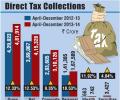
Direct tax collections totalled Rs 4.29 lakh crore (Rs 4.29 trillion) during the April-December period in 2012-13.
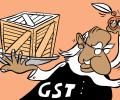
The central government has proposed just two tax rates of 5 per cent and 18 per cent in the revamped Goods and Services Tax (GST), slated to replace the current indirect tax regime by Diwali this year, highly placed sources said.

Around 24 paise will come from borrowings and other liabilities, 10 paise from non-tax revenue like disinvestment, and 2 paise from non-debt capital receipts, the Budget documents showed.
Taiwan in 1951 came up with an ingenious plan to improve tax compliance: citizens taking receipts for purchases could use them as lottery tickets. Customers were incentivized, and businesses found it hard to evade taxes. The plan's success prompted other countries, Slovakia and Greece among them, to launch similar initiatives. India doesn't seem to find the need yet for such schemes amid surging goods and services tax (GST) collections.

Foreign companies now pay less tax relative to their earnings than at any time in more than three decades. Foreign private companies paid 24.36 per cent of their pre-tax profit as tax in 2023-24, show numbers from the Centre for Monitoring Indian Economy (CMIE).

'Every year we import approximately $70 billion worth of gold -- closer to $72 billion in 2025-2026, an all-time record.' 'There is no parallel for this anywhere in the world. And this love for gold will not disappear overnight.'
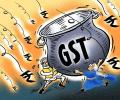
GST collections in July rose 10.3 per cent to over Rs 1.82 lakh crore, mainly driven by domestic transactions in goods and services, according to official data released on Thursday. This is the third-highest-ever monthly collection recorded since the indirect tax regime was rolled out 7 years ago on July 1, 2017. According to the data, total refunds stood at Rs 16,283 crore in July.
Net direct tax collection grew 21 per cent to over Rs 4.62 lakh crore so far this fiscal, on higher advance tax payment by corporates.
Goods and Services Tax collections jumped 10.4 per cent to over Rs 1.72 lakh crore in January, reflecting buoyant economic activity and setting the stage for the next phase of GST reforms. This is the second-highest monthly collection ever and marks the third month in this financial year with a collection of Rs 1.70 lakh crore or more, a finance ministry statement said on Wednesday.
Gross GST collections increased by 6.2 per cent to over Rs 1.84 lakh crore in June but slipped below the Rs 2 lakh crore mark recorded in the previous two months. Gross GST collections stood at Rs 173,813 crore a year ago, as per government data released on Tuesday.

Here are the key numbers to watch out for in the Union Budget for 2025-26:

'We are not incentivising the old tax scheme. These taxpayers will also shift to the new regime after comparison.'

For every rupee in the government coffer, the biggest pie of 66 paise will come from direct and indirect taxes, according to the Union Budget 2025-26 documents. Around 24 paise will come from borrowings and other liabilities, 9 paise from non-tax revenue like divestment, and 1 paise from non-debt capital receipts, the Budget documents said.

Mumbai, which adds 37 per cent to the total direct tax mop-up, has reported tax collection of Rs 4.93 trillion so far, against the full-year target of Rs 5.35 trillion.
